
Restoring Broken Relationships (A 5-day Devotional)
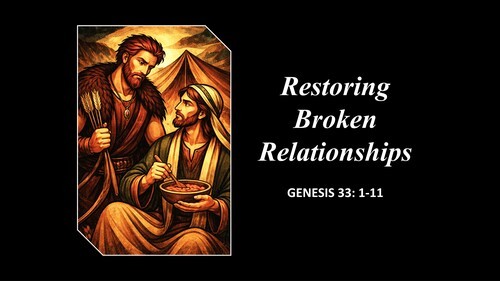
Day 1: Wrestling Leads to Transformation
Reading: Genesis 32:22-32
Before Jacob could reconcile with his brother, he had to wrestle with God. This divine encounter exposed his identity as "deceiver" and left him both wounded and transformed. True reconciliation begins when we allow God to confront the broken parts of our character. Like Jacob, we must be willing to limp away from our encounter with God—humbled, renamed, and changed. Transformation isn't comfortable; it requires honest wrestling with our failures and God's holiness. When we surrender to God's work in our hearts, He creates a readiness for reconciliation we couldn't manufacture ourselves. The question isn't whether God can change us, but whether we're willing to wrestle until He does.
Reflection: What area of your character is God asking you to wrestle with today?
Day 2: Love Covers a Multitude of Sins
Reading: 1 Peter 4:8-11
We naturally create caricatures of those who hurt us, reducing them to their worst moment while viewing ourselves as complex, multi-dimensional people. Peter's command to "love earnestly" challenges this distortion. Love doesn't deny sin or ignore pain, but refuses to let someone's failure have the final word over their life. When we cover sins with love, we see people as God sees them—image-bearers with dignity despite their flaws. This isn't naive optimism; it's gospel realism. We remember that Christ covered our multitude of sins, and this memory empowers us to extend the same grace. Love restores perspective, allowing us to see the hundreds of good qualities we've overlooked while fixating on one wrong.
Reflection: Who have you reduced to a one-dimensional villain? How can love restore proper perspective?
Day 3: Vertical Surrender Invites Horizontal Reconciliation
Reading: 2 Corinthians 5:16-21
God didn't just reconcile us to Himself—He entrusted us with the ministry and message of reconciliation. This isn't optional spirituality; it's core to our Christian identity. When we belong to the Lord, vertical surrender naturally flows into horizontal reconciliation. Paul's appeal to Euodia and Syntyche reveals the logic: "because you belong to the Lord, settle your disagreement." Our reconciliation with God through Christ creates a spiritual current that should carry us toward peace with others. Resisting reconciliation means resisting part of God's transforming work in us. The same grace that brought us to God compels us toward others—especially family members whose wounds run deepest. Reconciliation is the outward manifestation of inward gospel transformation.
Reflection: Is there a relationship where you're resisting God's call to reconciliation?
Day 4: Uncomfortable Humility Opens Doors
Reading: Ephesians 4:1-6
Jacob's seven-fold bowing before Esau wasn't quick or easy—especially with a damaged hip from wrestling God. Yet this radical humility reversed everything. The one who stole blessings now gave gifts. The one who fled now laid down his life. The one blessed to have others bow now bowed himself. Humility, gentleness, patience, and bearing with one another in love—these traits don't just accompany unity; they create it. Pride protects our dignity but destroys relationships. Humility protects relationships even at the cost of dignity. Most broken relationships remain broken because we won't become uncomfortably humble. We want to prove moral superiority rather than pursue peace. But reconciliation usually requires the kind of humility that makes us vulnerable, that takes the first step, that bows when we'd rather stand tall.
Reflection: What would uncomfortable humility look like in your strained relationship?
Day 5: Remember Grace When Tempted to Avoid Reconciliation
Reading: Matthew 18:21-35
Twice Jacob mentioned God's grace during his reconciliation with Esau. He came to this strained relationship with God's grace on his mind—remembering his failures, God's relentless pursuit, and undeserved favor. This is the gospel template for horizontal reconciliation. How can we receive God's extravagant grace knowing our deep flaws, yet withhold graciousness from the deeply flawed person before us? The parable of the unforgiving servant exposes this hypocrisy. When we truly grasp the gospel—God's radical pursuit of reconciliation despite our rebellion—it moves us, shapes us, and compels us toward others. Not everyone will receive our pursuit of peace, just as many reject God's offer. But the question remains: have you initiated the pursuit? As far as it depends on you, live at peace with everyone.
Reflection: How does remembering God's grace toward you change your approach to a difficult relationship?
Reading: Genesis 32:22-32
Before Jacob could reconcile with his brother, he had to wrestle with God. This divine encounter exposed his identity as "deceiver" and left him both wounded and transformed. True reconciliation begins when we allow God to confront the broken parts of our character. Like Jacob, we must be willing to limp away from our encounter with God—humbled, renamed, and changed. Transformation isn't comfortable; it requires honest wrestling with our failures and God's holiness. When we surrender to God's work in our hearts, He creates a readiness for reconciliation we couldn't manufacture ourselves. The question isn't whether God can change us, but whether we're willing to wrestle until He does.
Reflection: What area of your character is God asking you to wrestle with today?
Day 2: Love Covers a Multitude of Sins
Reading: 1 Peter 4:8-11
We naturally create caricatures of those who hurt us, reducing them to their worst moment while viewing ourselves as complex, multi-dimensional people. Peter's command to "love earnestly" challenges this distortion. Love doesn't deny sin or ignore pain, but refuses to let someone's failure have the final word over their life. When we cover sins with love, we see people as God sees them—image-bearers with dignity despite their flaws. This isn't naive optimism; it's gospel realism. We remember that Christ covered our multitude of sins, and this memory empowers us to extend the same grace. Love restores perspective, allowing us to see the hundreds of good qualities we've overlooked while fixating on one wrong.
Reflection: Who have you reduced to a one-dimensional villain? How can love restore proper perspective?
Day 3: Vertical Surrender Invites Horizontal Reconciliation
Reading: 2 Corinthians 5:16-21
God didn't just reconcile us to Himself—He entrusted us with the ministry and message of reconciliation. This isn't optional spirituality; it's core to our Christian identity. When we belong to the Lord, vertical surrender naturally flows into horizontal reconciliation. Paul's appeal to Euodia and Syntyche reveals the logic: "because you belong to the Lord, settle your disagreement." Our reconciliation with God through Christ creates a spiritual current that should carry us toward peace with others. Resisting reconciliation means resisting part of God's transforming work in us. The same grace that brought us to God compels us toward others—especially family members whose wounds run deepest. Reconciliation is the outward manifestation of inward gospel transformation.
Reflection: Is there a relationship where you're resisting God's call to reconciliation?
Day 4: Uncomfortable Humility Opens Doors
Reading: Ephesians 4:1-6
Jacob's seven-fold bowing before Esau wasn't quick or easy—especially with a damaged hip from wrestling God. Yet this radical humility reversed everything. The one who stole blessings now gave gifts. The one who fled now laid down his life. The one blessed to have others bow now bowed himself. Humility, gentleness, patience, and bearing with one another in love—these traits don't just accompany unity; they create it. Pride protects our dignity but destroys relationships. Humility protects relationships even at the cost of dignity. Most broken relationships remain broken because we won't become uncomfortably humble. We want to prove moral superiority rather than pursue peace. But reconciliation usually requires the kind of humility that makes us vulnerable, that takes the first step, that bows when we'd rather stand tall.
Reflection: What would uncomfortable humility look like in your strained relationship?
Day 5: Remember Grace When Tempted to Avoid Reconciliation
Reading: Matthew 18:21-35
Twice Jacob mentioned God's grace during his reconciliation with Esau. He came to this strained relationship with God's grace on his mind—remembering his failures, God's relentless pursuit, and undeserved favor. This is the gospel template for horizontal reconciliation. How can we receive God's extravagant grace knowing our deep flaws, yet withhold graciousness from the deeply flawed person before us? The parable of the unforgiving servant exposes this hypocrisy. When we truly grasp the gospel—God's radical pursuit of reconciliation despite our rebellion—it moves us, shapes us, and compels us toward others. Not everyone will receive our pursuit of peace, just as many reject God's offer. But the question remains: have you initiated the pursuit? As far as it depends on you, live at peace with everyone.
Reflection: How does remembering God's grace toward you change your approach to a difficult relationship?